
Google Maps Changes Spark User Concerns
Recent changes to Google Maps have sparked debate among users who prefer browsing without logging in. Many noticed that the interface now feels noticeably emptier when accessed as a guest. Information that once appeared instantly has disappeared, while Google suggests that logging in resolves the issue. Because of this, users question whether the change is intentional rather than a technical glitch.
What Logged-Out Users Can No Longer See
When users browse Google Maps without an account, they now see only basic location details such as addresses, phone numbers, and opening hours. However, reviews, user-uploaded photos, videos, and crowd density graphs often remain hidden. These features previously required no personal account to view. As a result, the experience feels stripped down and far less informative.
This limitation feels different from features that clearly need accounts, such as saving places or syncing routes. In this case, Google appears to restrict public information to encourage login behavior.
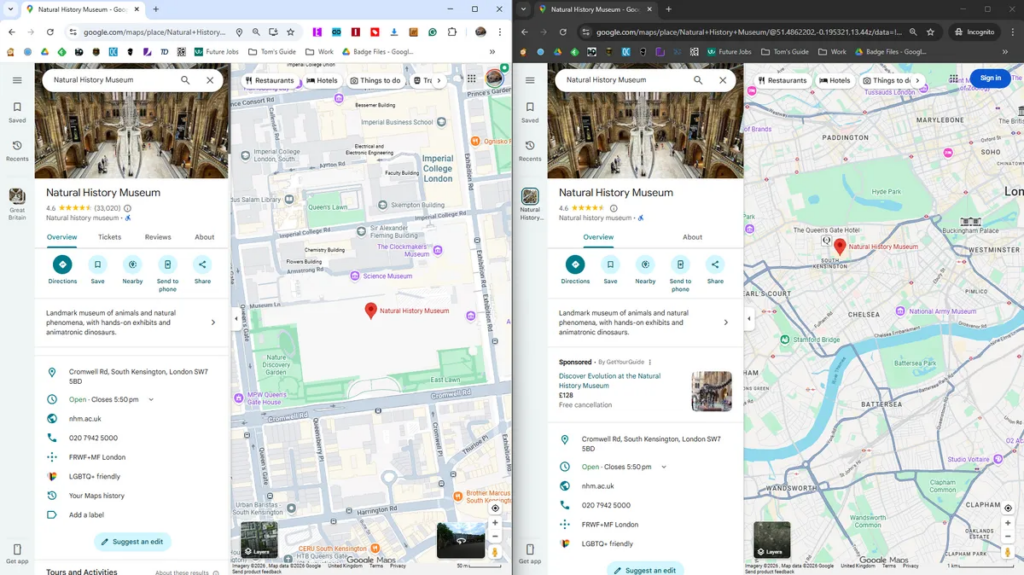
A Clear Difference After Logging In
Comparisons between logged-in and logged-out sessions show a sharp contrast. Logged-in users can access full reviews, ticket links, photos, and detailed amenity information. Meanwhile, guest users see only star ratings and short summaries. Even parking details and facility notes may disappear, which makes trip planning more difficult for privacy-focused users.
Why This Strategy Raises Red Flags
Google Maps became dominant because it combined convenience with depth in one place. By limiting access, Google risks weakening that core strength. Many users believe the push to log in supports Google’s advertising model, which relies on personal data for targeting. Therefore, reducing functionality for guests feels less like improvement and more like pressure.
Community Reactions and Unanswered Questions
Users on Reddit have tracked this behavior for some time. Yet Google has not issued a clear statement confirming whether this change is a bug or a permanent policy. This silence fuels frustration and uncertainty. If intentional, the move could push users toward alternatives such as Apple Maps or Waze, which still offer rich data without forced login.
Long-Term Risks for Google Maps
Forcing users rarely builds loyalty. Instead, it often leads to resistance or migration to competing services. If Google wants Maps to remain the default choice, it must provide clear value that encourages voluntary login. Convenience earns trust far more effectively than restriction.
According to reporting by Tom’s Guide, this shift highlights a growing tension between privacy and platform control. How Google responds next may decide whether Maps keeps its lead or drives users away.
Origin: Tomsguide